
Report of the Department of Justice on October 4, 2023 Use of Force by the Delaware State Police
Scope and Purpose of the Investigation
This is the final report of the Delaware Department of Justice, Division of Civil Rights and Public Trust (“DCRPT”) arising out of the investigation into the use of deadly force by Corporal William Schuele of the Delaware State Police against Jordan James (“James”). Per Title 29 § 2553 of the Delaware Code, DCRPT shall “[i]nvestigate the use of deadly force incidents by law enforcement…for the purpose of determining whether such use of force was justified as a matter of law.”1 Independent of any administrative or criminal investigation conducted by any law enforcement agency, DCRPT investigators and attorneys reviewed evidence consisting of video footage, victim and witness interviews, police interviews, scene photographs, forensic evidence, and medical records.
This investigation is limited to determining whether a law enforcement officer’s use of deadly force constitutes a criminal act. The purpose of this investigation is not to establish, enforce, or evaluate internal police policies concerning the proper use of deadly force by law enforcement officers. Law enforcement agencies are responsible for establishing and enforcing guidelines for the use of force by their officers and determining whether an officer’s whether Cpl. Schuele’s actions complied with the agencies internal policies concerning the proper use of deadly force.
Facts
On October 4, 2023, at approximately 10:50 pm, police responded to a reported home invasion at Canterbury Apartments in Bridgeville. James fled prior to police arrival but was described as a Black male, named “Jordy” or “Jordan,” who was approximately 5’10” wearing black clothing and a mask armed with a shotgun.
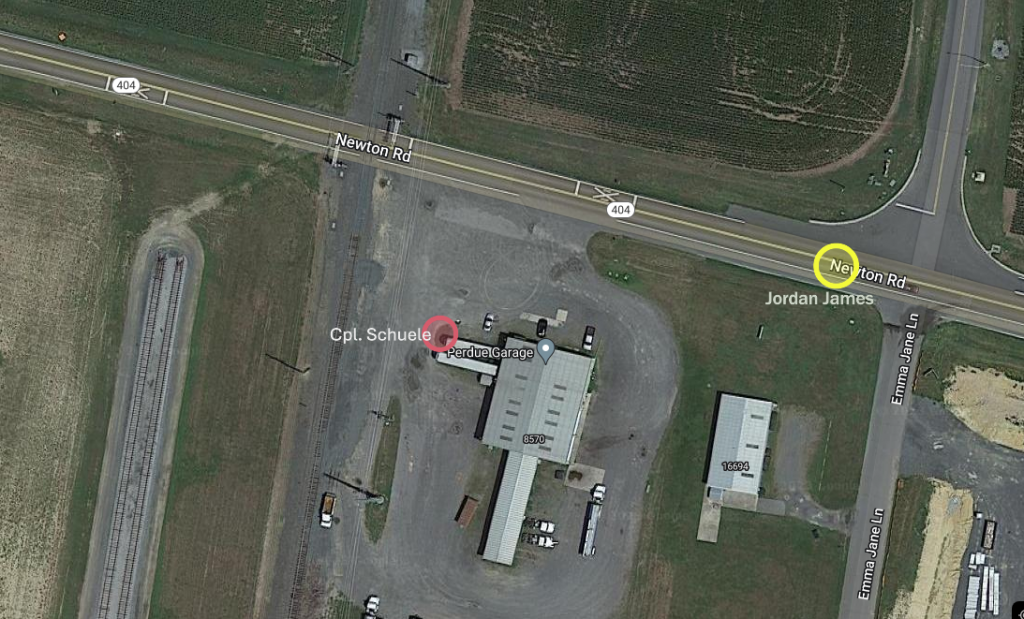
Approximately 30 minutes later, Jordan James arrived at the nearby Perdue Feed Mill, where he worked. He interacted with two co-workers, including hugging them and saying it was his “last day.” He walked away from them and then came back carrying a long gun while repeatedly stating “call the fucking cops.” One of his co-workers called 911 and stated an employee named Jordan James showed up “out of the blue” at the Feed Mill and was wearing black clothing, a mask, and was armed with a “machine gun.
Officers from DSP Troop 5, Bridgeville PD, and Greenville PD responded to the Feed Mill. Troopers Schuele and Santmyer responded to a poorly lit area north of the Feed Mill along nearby railroad tracks. While making their way to train cars for cover, Cpl. Santmyer turned around and saw James closing in behind them. Cpl. Santmyer called out to James and commands him to show his hand. James fired his gun in an unknown direction and ran.
Cpl. Santmyer and Cpl. Schuele pursued James and made their way to opposite corners of a warehouse for coverage. James fired another round. Cpl. Schuele fired his rifle twice in response. James was found lying in the street by other officers. James’s finger was in the trigger guard of his 9mm rifle. The rifle was removed from James and officers began lifesaving measures, but ultimately James succumbed to a gunshot wound to his head.
Evidence
DCRPT investigators and attorneys reviewed evidence consisting of video footage, victim and witness interviews, police interviews, scene photographs, forensic evidence, and medical records. Although all evidence was reviewed, only the evidence relevant to this report is summarized below.
Delaware State Police evidence technicians collected ballistic evidence from the shooting scene near the Perdue Feed Mill, as well as the HiPoint 9mm rifle held by James, and Cpl. Schuele’s divisionally issued Sig Sauer .223 rifle. The Delaware State Police Forensic Firearms Services Unit conducted ballistics analysis. A cartridge casing fired from James’s rifle was found in the street near James. Two cartridge casings fired from Cpl. Schuele’s rifle were found near the corner of the warehouse where he eventually took cover, consistent with where he fired his rifle. Although a partial projectile was found in James’s clothing, ballistic analysis was unable to determine whether if it had been fired by either rifle collected in this case.
Cpl. Schuele’s body worn camera shows he and Cpl. Santmyer making their way along the railroad tracks and eventually encountering James for the first time. The sound of a gunshot is heard prior to both troopers taking cover and then pursuing James. It also shows Cpl. Schuele approaching a building when another gunshot is heard, at which point he takes a kneeling position and returns fire.
Cpl. Santmyer’s body worn camera shows him near the railroad tracks where he turns and encounters James. While trying to engage James a gunshot can be heard. Cpl. Schuele begins to pursue James as Cpl. Santmyer relays information to other officers and dispatch. Cpl. Santmyer also pursues James. A second gunshot is heard followed by two louder gunshots, consistent with Cpl. Schuele returning fire.
When officers approached James in the street, he had an apparent gunshot wound to his head. An autopsy was completed by the Division of Forensic Science. It confirmed that James died due to a gunshot wound to his head. James also had minor abrasions consistent with falling on asphalt.
Trooper Interview
Cpl. Schuele was interviewed. He stated that he had originally responded to Canterbury Apartments for a reported home invasion perpetrated by a black male who lived in the Coverdale area and worked at a local processing mill. James was looking for an individual who used to live at the residence in Canterbury. It was relayed over the radio that James was armed with a long gun and wearing all black and a mask. A short while later Cpl. Schuele heard dispatch relay that a black male wearing black and a mask had a machine gun at the Perdue Feed Mill, which was close to Canterbury Apartments. He immediately thought this individual was likely the same person who committed the home invasion.
When he arrived at the Feed Mill, Cpl. Schuele decided that he and Cpl. Santmyer would establish a perimeter north of the Feed Mill. While at the railroad tracks Cpl. Santmyer got his attention and when he turned around, he saw someone wearing all black and carrying a long gun. James fired the gun and began running toward the Feed Mill. Cpl. Schuele described thinking that he, Cpl. Santmyer, and people present at the Feed Mill were all in danger, so he pursued James. Cpl. Schuele describes hearing another gunshot ring out, so he fired twice at James, although he was unsure if he had hit him, so he maintained cover behind the warehouse.
Conclusion
The Delaware Department of Justice’s Division of Civil Rights and Public Trust determines whether a law enforcement officer’s use of deadly force constitutes a criminal act for which there is a reasonable belief that a conviction can be obtained.2 When determining the probability that a conviction can be obtained, the State is always cognizant that it has the burden to prove the crime(s) charged beyond a reasonable doubt, a demanding standard. Further, it must also consider the viability of any defenses to the crime(s) charged, and the likelihood of successfully presenting such defenses. Central to any analysis involving an officer’s use of force is the applicability of Delaware’s “Justification Defenses,” which are commonly referred to as its “self-defense laws.” These laws are codified in 11 Del. C. §§ 464, 465, and 467.
Title 11 § 464 of the Delaware Code defines the legal use of force in self-protection. It provides, in pertinent part, that “[t]he use of force upon or toward another person is justifiable when the [officer] reasonably believes that such force is immediately necessary for the purpose of protecting the [officer] against the use of unlawful force by the other person on the present occasion.” “[An officer] using protective force may estimate the necessity of such force, under the circumstances that the person believes to exist.”3 Title 11 § 464(c) through (e) specifically address the use of deadly force, stating that it is justifiable “if the [officer] reasonably believes that such force is necessary to protect the [officer] against death [or] serious physical injury[.]”4 Subsection 464(e)(2)(C) articulates that law enforcement officers are not required to retreat, nor refrain from making an arrest or preventing an escape because James is resisting, to be justified in their use of deadly force in the performance of their duties.
The State must also consider whether the use of deadly force by the officers was justified under 11 Del. C. § 465 of the Delaware Code, which involves the use of force for the protection of others.5 The same legal principles that apply to self-defense, apply to the defense of others.6 Lastly, 11 Del. C. § 467 sets forth a justification defense specific to the use of force in law enforcement. It allows officers to use force when they reasonably believe that such force is immediately necessary to make an arrest. Subsection (c) of § 467 limits the circumstances under which an officer may use deadly force to make an arrest or apprehend a fleeing suspect. First, the officer may only use deadly force to make an arrest “if all other reasonable means of apprehension have been exhausted.”7 Second, the arrest must be for a crime involving physical injury. Third, the use of deadly force must not create a substantial risk of injury to an innocent person. Lastly, the officer “reasonably believes that there is a substantial risk that the person to be arrested will cause death or serious physical injury or will never be captured if apprehension is delayed.”8
Under Delaware law, the objective facts and circumstances must be considered when determining whether the use of force was justifiable against another person. The specific factual inquiry is two-pronged. The first question is whether the officer(s) “reasonably believed,” at the time they intentionally used deadly force, that such action was necessary to protect themselves or others from death or serious physical injury, or to prevent the flight of a suspect where the officer reasonably believed that there was an imminent and substantial risk that James would cause death or serious physical injury to another person. When applied to a person who is a law enforcement officer acting in their official capacity “reasonably believes” means “holds a belief that is reasonable from the viewpoint of a reasonable law enforcement officer” in the same situation under the circumstances.9 The second question is whether the officer was reckless or negligent in having such belief, or in acquiring or failing to acquire any knowledge or belief, which is material to the justifiability of the use of force.10
Cpl. Schuele’s use of deadly force was justified for the purpose of self-protection and the protection of others. At the time deadly force was used, James had fired his weapon twice- first when directly confronted by troopers and a second time when troopers were pursuing him. A review of the relevant evidence, including the body worn camera, confirms the timeline of events. Cpl. Schuele’s determination that deadly force was necessary under the circumstances in which he found himself was reasonable.
Finally, 29 Del C. § 2553(a)(3)(b) requires as a matter of law that if DCRPT issues a public report on the use of force, the report must include the race of the law enforcement officer who used force, the race of the individual on whom force was used, and whether race was a relevant or motivating factor. Cpl. Schuele’s race is white, and James’s race is black; however, race was not found to be a relevant or motivating factor in this case.
Upon careful consideration of the available evidence, Cpl. Schuele reasonably believed that the use of deadly force against James was immediately necessary for the protection of himself and others. As a result, the Department of Justice concludes the use of deadly force in this case does not constitute a criminal offense under the laws of the State of Delaware.
Notes
1 29 Del. C. § 2553(a)(3).
2 Delaware Department of Justice Criminal Division Policy Manual citing NDAA National Prosecution Standards (2nd Ed. 1991) §§ 43.3; NDAA National Prosecution Standards (4
th Ed. 2024, 4-2.2) “While commencing a prosecution is permitted by most ethical standards upon a determination that probable cause exists to believe that a crime has been committed and that the defendant has committed it, the standard prescribes a higher standard for filing a criminal charge. To suggest that the charging standard should be the prosecutor’s reasonable belief that the charges can be substantiated by admissible evidence at trial is recognition of the powerful effects of the initiation of criminal charges.”
3 11 Del. C. § 464(b); See Delaware Superior Court Pattern Jury Instruction 5.11 (2024).
4 11 Del. C. § 464(c)-(e).
5 “(a) The use of force upon or toward the person of another is justifiable to protect a third person when: (1) The defendant would have been justified under § 464 of this title in using such force to protect the defendant against the injury the defendant reasonably believes to be threatened to the person whom the defendant seeks to protect; and (2) Under the circumstances as the defendant reasonably believes them to be, the person whom the defendant seeks to protect would have been justified in using such protective force; and (3) The defendant reasonably believes that intervention is necessary for the protection of the other person.”
6 See 11 Del. C. § 465.
7 11 Del. C. § 467(c).
8 Id.
9 11 Del. C. § 471(e)(2).
10 11 Del. C. § 470(a).
Supplements & Downloads
Documents
Photos & Videos
Body Worn Camera Footage: Schuele
Body Worn Camera Footage: Santmyer
Viewer discretion advised. Because of their graphic nature, these videos are age-restricted.