
Report of the Department of Justice on May 31, 2024 Use of Force by the Delaware State Police
Scope and Purpose of the Investigation
This is the final report of the Delaware Department of Justice, Division of Civil Rights and Public Trust (“DCRPT”) arising out of the investigation into the use of deadly force by Delaware State Police Trooper Cpl. David Franck (“Franck”) against Jonathan M. Kreiser (“Kreiser”). Per Title 29 § 2553 of the Delaware Code, DCRPT shall “[i]nvestigate the use of deadly force incidents by law enforcement…for the purpose of determining whether such use of force was justified as a matter of law.”1 Independent of any administrative or criminal investigation conducted by any law enforcement agency, DCRPT investigators and attorneys reviewed evidence consisting of video footage, dispatch records, witness interviews, police interviews, scene photos and medical records.
The purpose of this investigation is limited to determining whether a law enforcement officer’s use of deadly force constitutes a criminal act. The purpose of this investigation is not to establish, enforce, or evaluate internal police policies concerning the proper use of deadly force by law enforcement officers. Law enforcement agencies are responsible for establishing and enforcing guidelines for the use of force by their officers and determining whether an officer’s actions were consistent with such guidelines in each case. This report expresses no opinion regarding whether the involved officer’s actions complied with the agencies internal policies concerning the proper use of deadly force
Facts
Around 9:19pm on May 31, 2024, a minor witness called 9-1-1 to report a suicidal man with a gun near 2917 Ferris Road in Wilmington, Delaware. Franck, who was on duty, was dispatched to the area. The following information was provided by the 9-1-1 caller and subsequently relayed to Franck over his police radio. The man with the gun was described as a white male, possibly in his thirties, dressed in shorts sitting on a curb. At the time the man identified himself as “Billy.” The dispatcher conveyed that “Billy” was threatening to shoot himself. The 9-1-1 caller indicated that he had taken a gun away from “Billy” but believed he had another gun. “Billy” indicated that he was going to shoot the police when they arrived. “Billy” could be heard in the background of the 9-1-1 call saying he was “ready to go out” and repeatedly saying that he was going to commit “suicide by cop.” Before Franck arrived on scene the dispatcher noted that the suspect, “Billy,” had a second firearm. It was later determined that “Billy” was Jonathon Kreiser.
Franck, dressed in full uniform and operating an unmarked Dodge Durango patrol vehicle, was the first police officer to arrive. Kreiser was seated on the curb with his left side exposed to Franck. There were also two minors present, standing near Kreiser.2 Franck activated the emergency lights on his patrol vehicle and gave Kreiser numerous commands to show him his right hand,3 which Kreiser refused. Franck asked for Kreiser’s name, and Kreiser identified himself as “Billy.” Kreiser threatened to shoot Franck with a second gun, which Kreiser said was in his right pocket, if Franck did not shoot him first. Kreiser then pivoted and pointed his right hand, still in his pocket, which he purported to be a gun, at Franck. Franck ordered Kreiser to take his hand out of his pocket. Kreiser then stood up and walked a short distance. He picked up a handgun and magazine from the sidewalk.
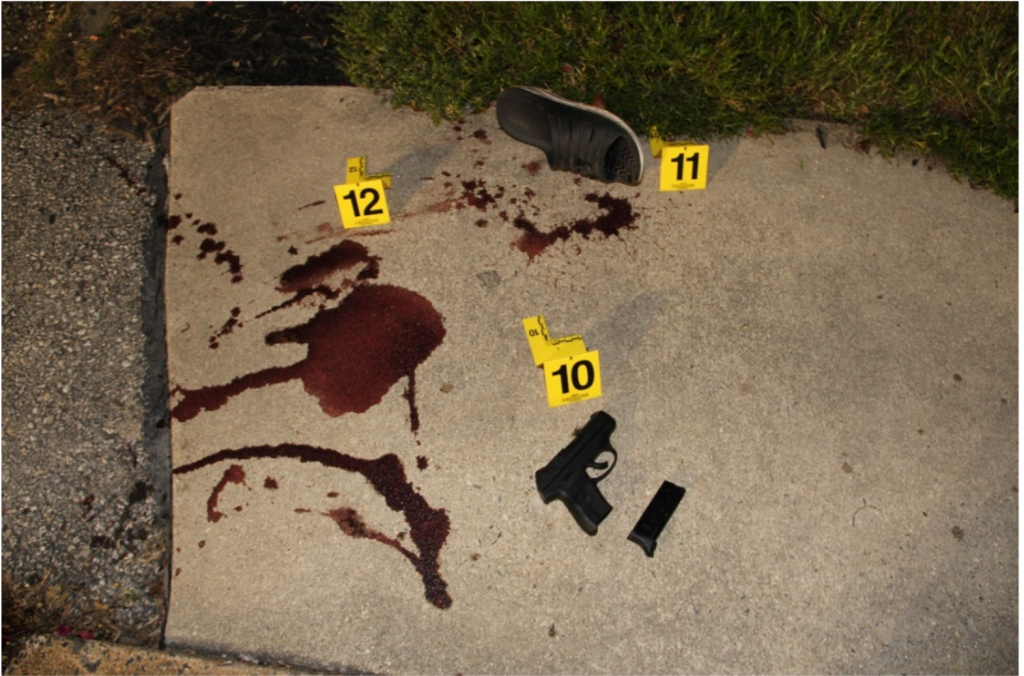
As Kreiser picked up the gun from the sidewalk, one of the minors called out that Kreiser was loading the gun. Franck gave Kreiser numerous commands to stop what he was doing,4 which Kreiser disregarded. Franck can be heard on his body worn camera pleading with Kreiser to stop what he is doing. Kreiser loaded the magazine into the handgun and raised it up towards Franck. Franck then fired seven shots at Kreiser until Kreiser dropped to the ground. The handgun that Kreiser had pointed at Franck was recovered from the sidewalk at the scene. Kreiser received emergency medical aid and was transported to Christiana Hospital. Kreiser survived the shooing and was treated for gunshot wounds to his stomach and right leg.
Earlier that day, Kreiser’s brother had reported Kreiser missing to the Smyrna Police Department and expressed concern that Kreiser may be suicidal, noting that Kreiser texted a photo of himself holding a firearm to his forehead.5 The Smyrna Police Department Issued a DIAC (Delaware Information and Analysis Center) “Gold Alert” and a missing person alert for Kreiser. In the alert, Kreiser is listed as a potentially suicidal subject who stole a firearm from his brother’s house. The alert advised that attempts to locate Kreiser had been unsuccessful and there was concern for his safety and well-being. Franck did not know at the time of the shooting that the man who identified himself as “Billy” was Kreiser.
Trooper Interview
Detectives Dan Grassi and Mark Csapo of the Delaware State Police interviewed Franck in the presence of Franck’s attorney on June 4, 2024 regarding this incident. Franck stated he was dispatched to the area of Ferris Road for a suspicious person or a person with a gun complaint. He noted that the report included something to the effect of “if the police come, he’s going to be involved with a shooting with them.”
Franck stated when he arrived, he observed a shirtless male sitting on the curb adjacent to the roadway along with minors standing near him. Franck stated he noticed the subject had his right hand in his pocket. Franck stated when he exited his vehicle, he started giving commands to Kreiser to show his hands. Franck stated the two minors put their hands up in the air and crossed the street, but Kreiser did not show his right hand, which was in his pocket. Franck stated that he gave Kreiser repeated commands to show his right hand, but Kreiser continued to refuse. Then, Franck says, he asked Kreiser his name and Kreiser identified himself as “Billy.” Franck says that he told Kreiser, “Billy, I can help you. Just please, don’t do this.” Kreiser responded by saying he would count to five and once he reached five, he would point a gun at Franck.
Franck stated after the subject counted to five, he turned his right side toward him with his hand in his pocket acting like he had a gun in his pocket. Franck stated he did not shoot at the time because he did not believe the subject had another gun on him. Franck stated that the subject then stood up and picked up a handgun from the sidewalk. Franck stated he remembered giving the subject numerous commands not to pick up the gun. Franck stated the subject inserted the magazine, racked a round, and immediately pointed the gun at Franck. Franck stated he fired several times and paused for a second. Franck stated it appeared to him the subject was still in control of the weapon and turning toward him. Franck stated he fired several more times at which time the subject fell to the ground. Franck stated he approached the subject and placed him into handcuffs. Franck said that assisting units arrived on scene soon thereafter and started rendering medical aid.
Franck stated that he did not become aware of the Gold Alert for Kreiser until after the shooting incident. When asked why he needed to use deadly force, Franck responded that he worried that Kreiser was either going to shoot him or the minors.
Witness Interviews
The two minors were also interviewed, separately, each in the presence of one of their parents. One of the minors (hereinafter “M-1”) stated that he/she and the other minor (hereinafter “M-2”) were riding their bikes on Ferris Road when they saw Kreiser, shirtless, carrying a handgun. Kreiser told M-1 that he was suicidal and wanted one of the minors to shoot him. M-1 was able to disarm Kreiser by agreeing to shoot Kreiser if Kreiser placed the handgun on the ground. Once the gun was on the ground, M-1 removed the magazine from the handgun and ejected a round from the chamber and threw the round into a grassy area across Ferris Road. M-1 then called 9-1-1. M-1 and M-2 stayed with Kreiser until Franck arrived and Franck ordered Kreiser to show his hands. At this point, M-1 and M-2 crossed the road. M-1 recalled that Kreiser told Franck that he had a gun in his pocket and threatened to shoot Franck if Franck failed to shoot him first. M-1 then recalled seeing Kreiser stand up, retrieve the handgun from the sidewalk and insert the magazine in the gun. He/she then observed that Kreiser was shot by Franck. M-1 also recorded the incident with his/her cellular phone camera and the recording was reviewed for this report. The interview of M-2 was consistent with and similar to that of M-1.
Conclusion
The Delaware Department of Justice’s Division of Civil Rights and Public Trust determines whether a law enforcement officer’s use of deadly force constitutes a criminal act for which there is a reasonable belief that a conviction can be obtained.6 When determining the probability that a conviction can be obtained, the State is always cognizant that it has the burden to prove the crime(s) charged beyond a reasonable doubt, a demanding standard. Further, it must also consider the viability of any defenses to the crime(s) charged, and the likelihood of successfully presenting such defenses. Central to any analysis involving an officer’s use of force is the applicability of Delaware’s “Justification Defenses,” which are commonly referred to as its “self-defense laws.” These laws are codified in Title 11 Sections 464, 465, and 467.
Title 11 § 464 of the Delaware Code defines the legal use of force in self-protection. It provides, in pertinent part, that “[t]he use of force upon or toward another person is justifiable when the [officer] reasonably believes that such force is immediately necessary for the purpose of protecting the [officer] against the use of unlawful force by the other person on the present occasion.” “[An officer] using protective force may estimate the necessity of such force, under the circumstances that the person believes to exist.”7 Title 11 § 464(c) through (e) specifically address the use of deadly force, stating that it is justifiable “if the [officer] reasonably believes that such force is necessary to protect the [officer] against death [or] serious physical injury[.]”8 Subsection 464(e)(2)(C) articulates that law enforcement officers are not required to retreat, nor refrain from making an arrest or preventing an escape because the suspect is resisting, to be justified in their use of deadly force in the performance of their duties. The State must also consider whether the use of deadly force by the officers was justified under Title 11 § 465 of the Delaware Code, which involves the use of force for the protection of others.9 The same legal principles that apply to self-defense, apply to the defense of others.10 Lastly, Title 11 § 467 sets forth a justification defense specific to the use of force in law enforcement. It allows officers to use force when they reasonably believe that such force is immediately necessary to make an arrest. Subsection (c) of § 467 limits the circumstances under which an officer may use deadly force to make an arrest or apprehend a fleeing suspect. First, the officer may only use deadly force to make an arrest “if all other reasonable means of apprehension have been exhausted.”11 Second, the arrest must be for a crime involving physical injury. Third, the use of deadly force must not create a substantial risk of injury to an innocent person. Lastly, the officer “reasonably believes that there is a substantial risk that the person to be arrested will cause death or serious physical injury or will never be captured if apprehension is delayed.”12
Under Delaware law, the objective facts and circumstances must be considered when determining whether the use of force was justifiable against another person. The specific factual inquiry is two-pronged. The first question is whether the officer “reasonably believed,” at the time they intentionally used deadly force, that such action was necessary to protect themselves or others from death or serious physical injury, or to prevent the flight of a suspect where the officer reasonably believed that there was an imminent and substantial risk that the suspect would cause death or serious physical injury to another person. When applied to a person who is a law enforcement officer acting in their official capacity “reasonably believes” means “holds a belief that is reasonable from the viewpoint of a reasonable law enforcement officer” in the same situation under the circumstances.13 The second question is whether the officer was reckless or negligent in having such belief, or in acquiring or failing to acquire any knowledge or belief, which is material to the justifiability of the use of force.14
In the instant matter, Franck believed that deadly force was necessary to protect himself and others from death or serious injury. Franck was aware that Kreiser had one or more firearms on or near his person at the time. Kreiser had threatened to shoot Franck if Franck did not shoot Kreiser first. Franck observed Kreiser retrieve a handgun from the sidewalk, load the magazine in it, rack the gun, and point it towards Franck. Franck was also aware that two minors were just across the street; if Kreiser was otherwise unsuccessful in provoking Franck to shoot him, Franck believed that Kreiser might resort to pointing the gun at one of the minors to hasten a response from Franck. Thankfully, the situation never escalated to the point where Kreiser resorted to aiming his handgun at the minors.
Franck’s beliefs regarding the need for deadly force for self-defense was reasonable, based upon his observations and facts known to him at the time—Kreiser has just raised a loaded handgun and pointed it towards Franck. Whether Franck reasonably believed that deadly force was necessary to protect the two minors is unclear. Under Title 11 § 465(a)(2), an officer may use force, even deadly force, to protect another when “the person whom the [officer] seeks to protect would have been justified in using such protective force[.]” Thus, in evaluating whether Franck reasonably believed deadly force was necessary for the protection of the minors, we should evaluate whether the minors themselves would have been justified in using deadly force under the circumstances based on facts known to Franck at the time. Franck was aware that the two minors had crossed the street and had gained some distance from Kreiser being separated by the roadway. The minors may have been closer to Kreiser than Franck was; both are visible on Franck’s body and dashboard cameras. Notably, however, Kreiser had not made any threats towards the minors, nor had he pointed his handgun in their direction. Accordingly, it is doubtful that the minors could have used deadly force in self-defense15 under the circumstances because they would not “reasonably believe[] that such force [was] immediately necessary” to protect themselves from unlawful force from Kreiser. 11 Del. C. § 464(a) (emphasis added). While it is commendable that Franck was aware of the presence of the minors and concerned for their well-being, we need not reach a conclusion on whether Franck was reckless or negligent in believing that force was justified on the basis of protecting the minors because we have already concluded that Franck’s actions are justified pursuant to Section 464.
Finally, 29 Del. C. § 2553(a)(3)(b) requires as a matter of law that if DCRPT issues a public report on the use of force, the report must include the race of the law enforcement officer who used force, the race of the individual on whom force was used, and whether race was a relevant or motivating factor. Both Franck and Kreiser are Caucasian. There is nothing to indicate that race is a relevant or motivating factor in this incident.
Upon careful consideration of the available evidence, Franck reasonably believed that the use of deadly force against Kreiser was immediately necessary for self-defense. As a result, the Department of Justice concludes the use of deadly force in this case does not constitute a criminal offense under the laws of the State of Delaware.
Notes
1 29 Del. C. § 2553(a)(3).
2 Soon after Franck ordered Kreiser to show his right hand, the minors crossed the street and were standing directly across the street from Kreiser. One of the minors recorded the incident with his/her cellular phone from that vantage point, which was reviewed for this report.
3 The video recording reflects at least 10 such commands to Kreiser to show his right hand.
4 Cpl. Franck gave more than 10 more warnings, shouting “do not do that” and “take your hand out of your pocket.”
5 The gun, a black Ruger LC9 EC9s 9mm handgun, was the same gun stolen from Kreiser’s brother earlier that day.
6 Delaware Department of Justice Criminal Division Policy Manual citing NDAA National Prosecution Standards (2nd Ed. 1991) §§ 43.3; NDAA National Prosecution Standards (4th Ed. 2024, 4-2.2) “While commencing a prosecution is permitted by most ethical standards upon a determination that probable cause exists to believe that a crime has been committed and that the defendant has committed it, the standard prescribes a higher standard for filing a criminal charge. To suggest that the charging standard should be the prosecutor’s reasonable belief that the charges can be substantiated by admissible evidence at trial is recognition of the powerful effects of the initiation of criminal charges.”
7 11 Del Code § 464(b); See Delaware Superior Court Pattern Jury Instruction 5.11 (2024).
8 11 Del Code § 464(c)-(e).
9 “(a) The use of force upon or toward the person of another is justifiable to protect a third person when: (1) The defendant would have been justified under § 464 of this title in using such force to protect the defendant against the injury the defendant reasonably believes to be threatened to the person whom the defendant seeks to protect; and (2) Under the circumstances as the defendant reasonably believes them to be, the person whom the defendant seeks to protect would have been justified in using such protective force; and (3) The defendant reasonably believes that intervention is necessary for the protection of the other person.”
10 See 11 Del. Code § 465
11 11 Del. Code § 467(C)
12 Id.
13 11 Del. Code § 471(e)(2).
14 11 Del. Code § 470(a).
15 Although the minors could have used force for the protection of others pursuant to Section 465 to protect Franck for the same reasons that Franck was justified in acting in self-defense pursuant to Section 464.
Supplements & Downloads
Documents
Photos & Videos
Viewer discretion advised. Because of their graphic nature, these videos are age-restricted.
Video: Franck Body Worn Camera Footage